
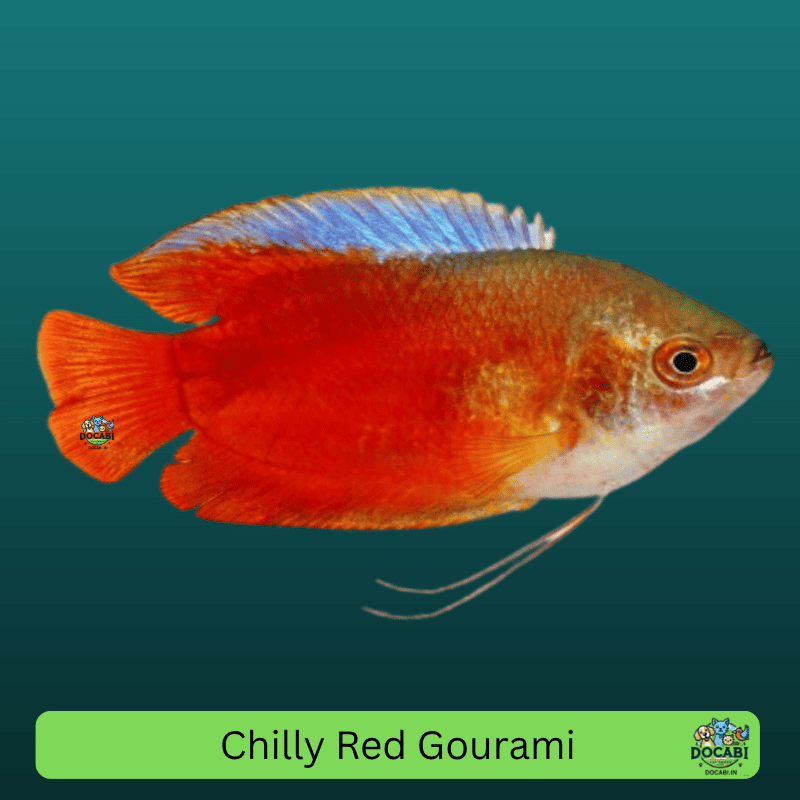
Chili Red Gourami: complete care guide
(1pc) Chilly Red Gourami – Osphronemus goramy (Size 1.25″- 2.25″) small – Docabi.in
“Chili red gourami” usually refers to a selectively bred red honey gourami, a small freshwater fish sold under names such as red honey gourami, sunset honey gourami, flame honey gourami, or chili gourami. Its exact color and quality can vary between breeders and stores, so check the scientific name when buying.
Basic profile
Feature
Information
Scientific name Usually Trichogaster chuna
Adult size About 4–5 cm, occasionally slightly larger
Lifespan Commonly 3–5 years with good care
Origin Slow-moving waters of India and Bangladesh
Temperament Peaceful, shy, generally community-safe
Water type Freshwater
Swimming level Mostly middle and upper areas
Difficulty Beginner to intermediate
Typical behavior Calm exploration, hiding, surface breathing, bubble-nest building
Appearance
Chili red gouramis are usually orange-red to deep reddish-brown. Males are often brighter, especially when displaying or breeding. Females tend to be paler, more rounded, and sometimes show a darker horizontal stripe.
Color can fade when the fish is:
Stressed
Newly introduced
Poorly fed
Kept in unsuitable water
Dominated by tank mates
Sick or suffering from poor water quality
They possess thread-like pelvic fins, which they use to sense their surroundings. #Docabi
Aquarium requirements
Tank size
One fish: around 40–45 liters is a practical minimum.
A pair or small group: approximately 60 liters or more.
A larger tank is preferable for community setups.
They are small, but they appreciate plants, gentle water movement, and stable conditions. A long aquarium is generally better than a tall, narrow one.
Water parameters
Aim for stable, clean water rather than chasing exact numbers:
Temperature: 23–28°C
pH: approximately 6.0–7.5
Hardness: soft to moderately hard
Ammonia: 0
Nitrite: 0
Nitrate: preferably below 20 ppm
Avoid sudden changes in temperature, pH, or hardness. Stability is particularly important because gouramis can be sensitive to poor water quality.
Filtration and flow
Use gentle filtration. Strong currents may stress them because they naturally inhabit slow-moving, heavily vegetated water.
Good options include:
Sponge filters
Air-powered filters
Hang-on-back filters with the flow reduced
Canister filters with a spray bar or diffuser
The aquarium should have a lid because gouramis breathe atmospheric air and may jump. Leave a warm, humid air space above the water; very cold or dry air can irritate their labyrinth organ.
Aquarium setup
A suitable setup should include:
Dense live plants
Floating plants with open areas between them
Driftwood or small caves
A dark or natural-colored substrate
Gentle lighting
Open swimming space
Some surface cover, but not a completely blocked surface
Good plants include:
Java fern
Anubias
Cryptocoryne
Vallisneria
Water sprite
Hornwort
Java moss
Amazon frogbit or other floating plants
Avoid filling the entire surface with floating plants, since the fish still need regular access to atmospheric air.
Diet
Chili red gouramis are omnivores and usually accept prepared foods.
Offer a varied diet consisting of:
High-quality micro pellets
Crushed tropical flakes
Frozen or live brine shrimp
Daphnia
Bloodworms occasionally
Small insect-based foods
Feed small portions once or twice daily. They have small mouths, so food should be appropriately sized. Only give what they can consume within roughly one or two minutes.
A varied diet helps maintain:
Strong color
Growth
Immune function
Breeding condition
Do not rely heavily on bloodworms or very rich foods, as overfeeding can cause obesity and water-quality problems.
Temperament and tank mates
They are generally peaceful but can be timid. Suitable tank mates include other calm, similarly sized fish such as:
Small rasboras
Ember tetras
Cardinal or neon tetras, in suitable water conditions
Small danios, if the current and activity level are not excessive
Corydoras
Otocinclus
Peaceful small livebearers
Small, non-aggressive shrimp, although baby shrimp may be eaten
Avoid combining them with:
Tiger barbs
Large or aggressive gouramis
Bettas with aggressive personalities
Large cichlids
Fin-nipping fish
Very fast, boisterous fish
Large predatory species
Although they are peaceful, males may chase one another, particularly in small or sparsely decorated tanks. In a small aquarium, keeping one individual is often easiest. In a larger, well-planted aquarium, a male and one or more females may work better.
Sexing
Sexing young fish can be difficult.
Males often have:
Stronger red, orange, or reddish-brown coloration
A more pointed dorsal fin
More intense breeding coloration
A slimmer appearance
Females often have:
A paler silver, beige, or yellow-brown color
A fuller body
A more rounded dorsal fin
A visible dark lateral stripe in some individuals
Color differences are not always reliable because commercial color strains can vary.
Breeding
Males build bubble nests near the surface, usually among floating plants. Breeding is possible in a mature, peaceful, planted aquarium.
Basic breeding conditions: #fish
Use warm, clean, calm water.
Provide floating plants or a broad leaf near the surface.
Offer nutritious foods such as live or frozen small invertebrates.
The male creates a bubble nest.
The pair spawn beneath the nest.
The male places the eggs in the bubbles and guards them.
Remove the female if the male becomes aggressive.
Once the fry hatch and begin free swimming, remove the male if necessary.
Feed fry very small foods, such as infusoria or commercial liquid fry food, followed later by newly hatched brine shrimp.
Breeding is easier in a separate shallow tank. The fry are tiny and require excellent water quality and appropriately sized food.
Common health problems
Stress and color loss
Possible causes include:
Poor water quality
Harassment from tank mates
Lack of cover
Sudden water changes
Transport stress
Inadequate diet
Ich
White spots, scratching, clamped fins, or lethargy may indicate ich. Quarantine new fish and treat according to a reputable aquarium medication’s instructions.
Bacterial infections
Symptoms may include:#fishbreeding
Ulcers
Red streaks
Fin deterioration
Swelling
Loss of appetite
Good water quality and quarantine are important preventive measures.
Internal parasites
Possible signs include:
Weight loss despite eating
White, stringy feces
Poor appetite
Hollow belly
Use a species-appropriate, evidence-based treatment and quarantine affected fish.
Gourami iridovirus concern
Some gouramis, particularly certain dwarf gourami strains, have a reputation for viral disease. Chili red or honey gouramis are not identical to dwarf gouramis, but poor breeding and questionable stock can still lead to health problems. Buy from reputable suppliers, observe fish before purchase, and avoid fish that are thin, inactive, breathing heavily, or showing lesions.
Signs of a healthy fish
Look for a gourami that:
Swims actively but calmly
Has intact fins
Shows clear eyes
Has a full but not swollen body
Eats readily
Breathes normally
Reacts to movement outside the aquarium
Has no white spots, sores, or fuzzy growths
Avoid fish that remain at the bottom, gasp continuously, have sunken bellies, or show severe discoloration.
Maintenance routine
A simple routine is:
Change 20–30% of the water weekly
Use dechlorinated, temperature-matched water
Siphon visible waste
Clean filter media in removed aquarium water, not untreated tap water
Test ammonia and nitrite regularly, especially in a new aquarium
Avoid replacing all filter media at once
Keep the tank well planted but not overcrowded
The aquarium should be fully cycled before adding the fish.
Important buying note
The name “chili red gourami” is not always used consistently. Before buying, verify:
Scientific name
Expected adult size
Whether it is a honey gourami or another gourami variety
Whether the fish is captive-bred
Whether it is eating normally
Whether it has been quarantined
In general, a genuine chili-red honey gourami is a peaceful, attractive nano-community fish that does best in a warm, planted, mature aquarium with gentle filtration and calm tank mates.
#comprehensive
#Guide
#Anupamaquariumlovers