
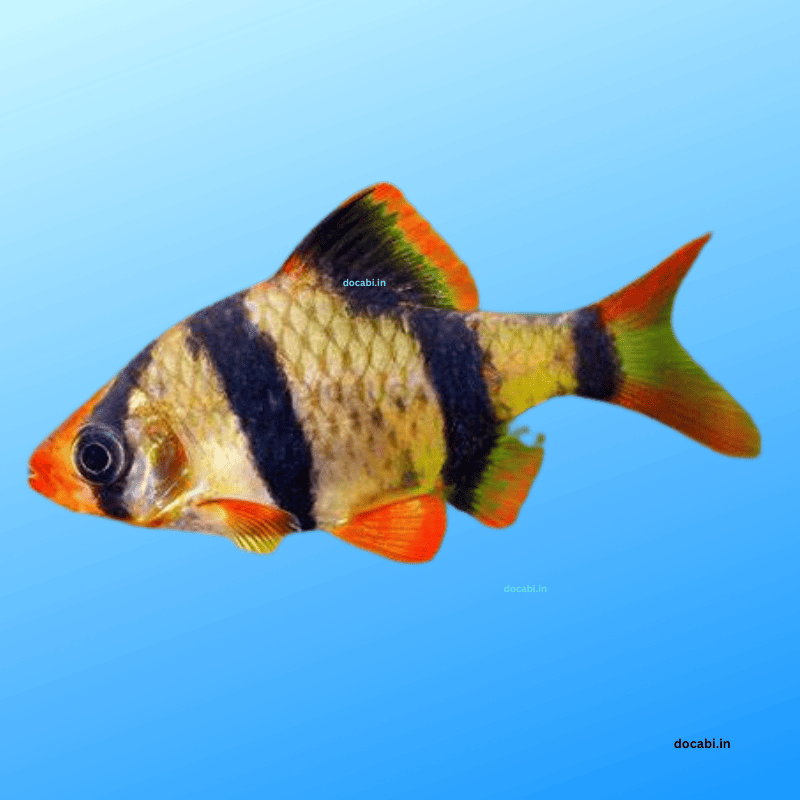
Tiger Barbs (Puntigrus tetrazona) are lively, semi-aggressive freshwater fish known for their bold orange-and-black stripes, shoaling behavior, and fin-nipping tendencies. They thrive in groups of 6–10, live 5–7 years, and need at least a 20–30 gallon tank with warm, slightly acidic water.
🌍 Origins & Habitat
- Native range: Sumatra, Borneo, Malay Peninsula.
- Wild environment: Clear forest streams, peat swamps, and tributaries with sandy substrate, driftwood, and dense vegetation.
- Water parameters in nature: 72–80°F (22–26°C), pH 6.0–6.8, soft to moderately hard water.
🎨 Appearance
- Size: 2.5–3 inches (6.5–8 cm).
- Colors: Classic orange-gold body with four vertical black stripes.
- Variants: Green (moss), albino, platinum morphs — all behave identically.
- Body type: Stocky, fast swimmers with bold shoaling behavior.
🐟 Behavior & Temperament
- Semi-aggressive: Known for fin-nipping, especially if kept in small groups.
- Shoaling species: Must be kept in schools of at least 6–8 to diffuse aggression.
- Activity: Very active mid-water swimmers; they establish dominance hierarchies.
🛠️ Care Requirements
- Tank size: Minimum 20 gallons for 6 fish; 30+ gallons recommended for 8–10.
- Water temperature: 74–79°F (ideal ~76°F).
- pH: 6.0–7.0.
- Filtration: Moderate current with hang-on-back or canister filters.
- Substrate: Sand or fine gravel; not fussy.
- Aquascaping: Open swimming space with plants and driftwood.
🍽️ Diet
- Omnivores: Accept flakes, pellets, live/frozen foods (bloodworms, daphnia, brine shrimp).
- Feeding tip: Variety enhances color and health.
- Schedule: 2–3 small feedings daily.
🧬 Breeding
- Setup: Separate breeding tank with fine-leaved plants or spawning mops.
- Method: Egg scatterers; parents do not guard eggs.
- Care: Remove adults after spawning; fry need infusoria or micro foods initially.
⚠️ Risks & Challenges
- Fin-nipping: Avoid housing with slow or long-finned fish (e.g., angelfish, bettas).
- Stress/aggression: Too few barbs or small tanks increase hostility.
- Health issues: Susceptible to ich, fin rot, velvet, and swim bladder problems if stressed.
📊 Quick Facts Table
| Scientific name | Puntigrus tetrazona |
|---|---|
| Size | 2.5–3 in (6.5–8 cm) |
| Lifespan | 5–7 years |
| Diet | Omnivore |
| Tank size | 20–30 gallons |
| Behavior | Semi-aggressive, shoaling |
| Breeding | Egg scatterer |